
Vehicle trip log software
Trip logs usually get filled in at the end of the month, from memory and a pile of receipts — while the accountant is separately trying to work out which line of the fuel invoice belongs to which car. In Ezura both halves run off the same document: the fuel station invoice that reaches your accounting anyway becomes both the fill lines on a driver's trip log and a summary showing every transaction, the lines nothing was matched to, and the year's litres for the pollution tax.
Opening balance
18.4 l
Filled
199.6 l
Used
186.2 l
Closing balance
31.8 l
| Date | Route and purpose | Km | Filled, l |
|---|---|---|---|
| 08-04 | Vilnius – Kaunas – Vilnius · site inspection | 212 | 62.4 |
| 08-11 | Vilnius · supplier visits | 48 | — |
| 08-18 | Vilnius – Panevėžys · materials delivery | 286 | 71.0 |
- Fills come from fuel station invoices — matched by fuel card and number plate
- Every fuel transaction stays visible: date, station, card, litres and amount
- You can see which invoice lines were not matched to a vehicle, and for how much
- The fuel balance carries over from last month; nothing to calculate
- Norms are set per vehicle and can differ by month
- The environmental pollution tax is calculated from those same litres
- Drivers fill in on a phone or in a browser and see only their own vehicles
- A PDF trip log with the monthly summary, in one click
The fuel invoice is already in accounting — use it twice
A fuel station invoice isn't one entry; it's dozens of transactions with a date, a time, a card, litres and a price. Normally all of that disappears into a single monthly total.
Ezura keeps those transactions separately and ties them to a vehicle through the fuel card. So the same document that goes into accounting as a cost also fills the fills column of the trip log. Nothing is entered twice.
Every fuel transaction stays a separate line
On the accountant's side the month's fuel invoices are shown as they arrived — by seller and invoice number — and broken down by vehicle inside. Each vehicle shows its cards, litres and amount; expand it and every transaction is there with its date, time, station, product, quantity and card number.
So "what did this car cost this month" has an answer without any sorting by hand — and it is the same answer already sitting on the driver's trip log.
| Vehicle | Cards | Litres | Net |
|---|---|---|---|
KTE 995 Škoda Octavia | •••• 4417 | 133.4 | €189.42 |
JGN 412 VW Caddy | •••• 4418 | 208.9 | €296.64 |
LPR 077 Toyota RAV4 | •••• 4420, •••• 4431 | 96.2 | €141.10 |
3 lines not matched to a vehicle
€84.20 of the invoice is not covered by lines
| Fuel | Litres | Tonnes | Tax |
|---|---|---|---|
| Petrol | 1,942.0 | 1.4565 | €17.26 |
| Diesel | 4,108.5 | 3.4511 | €51.11 |
| Total for the year | €68.37 | ||
Indexing coefficient is provisional until this year's is published
What the invoice says, and what the lines don't
Fuel invoices are not tidy: some lines are a car wash or a coffee, a card may not be registered yet, and some lines are corrections against last month.
So each invoice shows the gap between the invoice amount and what was captured into lines, and separately the lines that could not be matched to any vehicle, with their value. It is not a general warning: you see how much, and where.
Credit notes are marked and kept out of the ordinary totals, so a re-issued invoice doesn't inflate the month's fuel cost.
A fuel balance that doesn't get lost between months
The opening balance is the most common trip-log error. If it comes from the wrong month, or is simply forgotten, every calculation after it is wrong — and it usually surfaces only at year end.
In the system the balance carries over from the previous month's close automatically. Looking back at an older month breaks nothing: browsing does not change the numbers of the months that follow.
Norms per vehicle, not per company
One norm for the whole fleet doesn't work: a van, a car and a hybrid consume differently, and winter consumption is higher than summer.
In Ezura the norm is set per vehicle, and winter months can carry their own value. Consumption and the closing balance are calculated from it.
The norm does need to be technically justified — from manufacturer data or the company's own methodology. The system will not invent it for you, but it will apply it consistently across every month.
When kilometres and litres disagree
The classic situation: 240 litres were bought, but the routes entered add up to a distance that should have needed 180. The difference has to be either explained or distributed.
The "fit kilometres" action shows how far the available fuel could have taken the vehicle and spreads the missing distance across the days already entered. Each day gets a capped adjustment, so a 40 km trip never becomes 400 — and if something doesn't fit, you are told rather than quietly rounded.
The driver fills in only what the driver knows
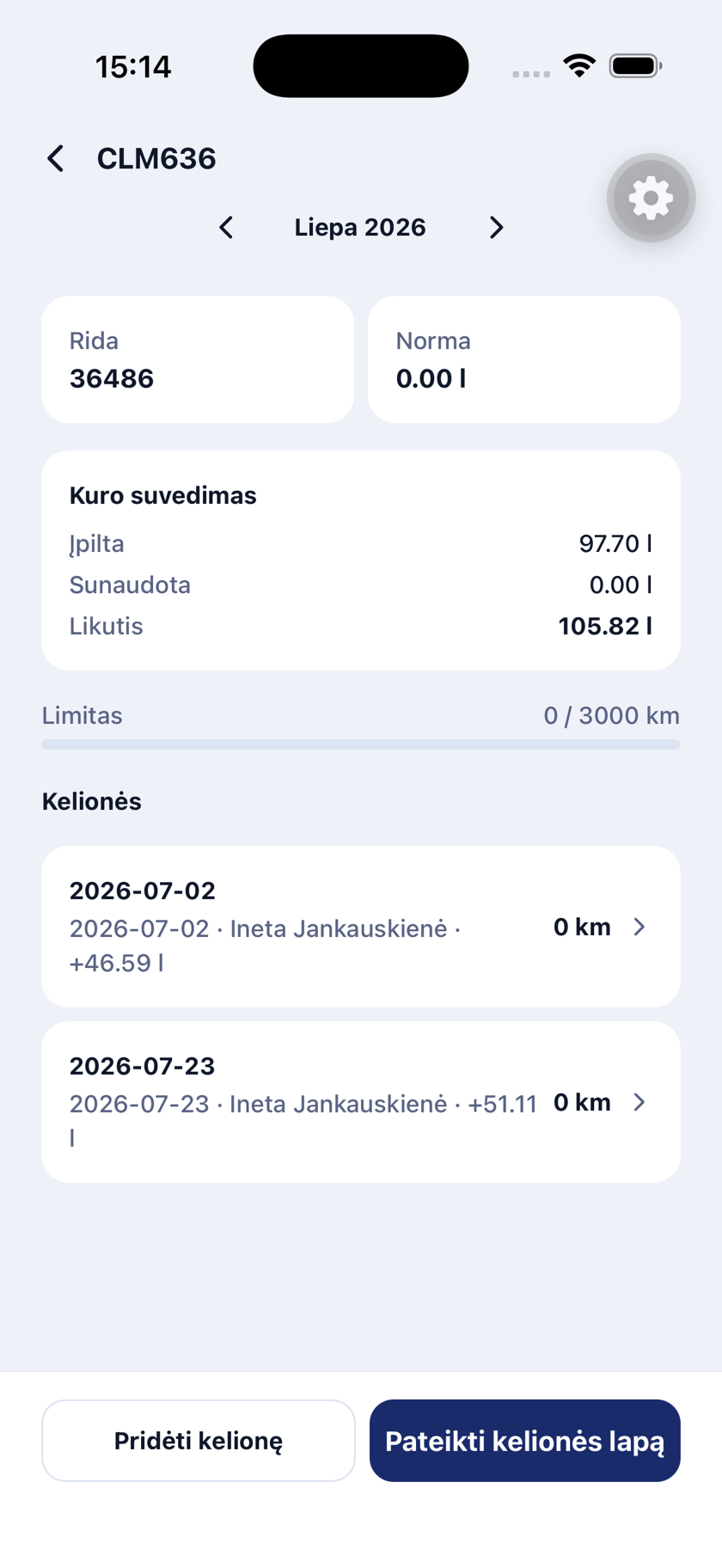
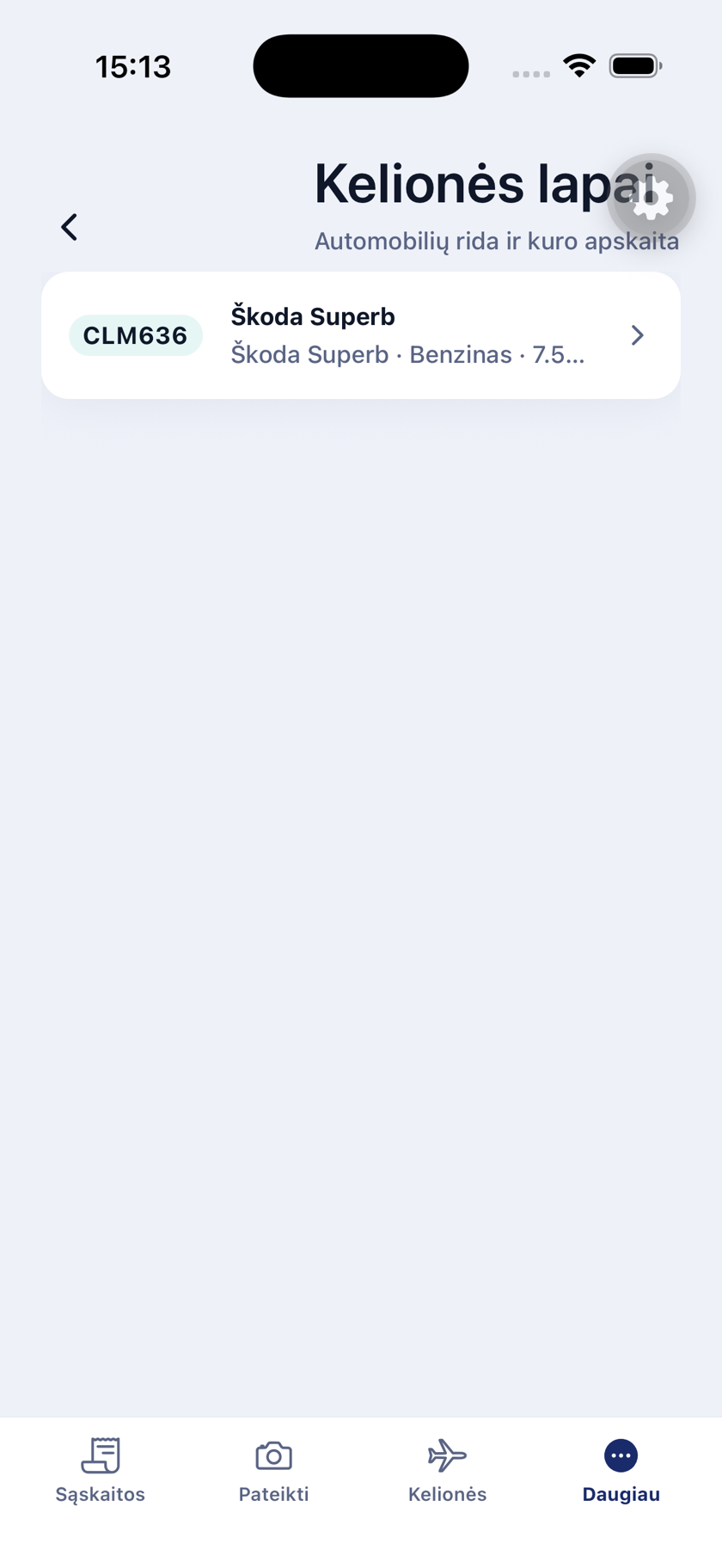
A driver sees only the vehicles assigned to them, and only the current month. Fills, balance and norm are already there — what's left is the date, the route and the kilometres.
It's filled in on a phone or in a browser, entries save themselves, and before submitting the driver can preview the same PDF the accountant will see.
The route and purpose are the most valuable part of a trip log — generic entries like "business travel" prove nothing — so that column deliberately stays with the person.
The accountant sees the whole fleet in one screen
You can see which vehicles have submitted a trip log for the month and which haven't — so nobody has to chase drivers one by one at month end.
The yearly summary gives each vehicle a row with litres per month, the year's total and the distance driven. That is where a car whose consumption drifts from its norm becomes obvious, and where you can tell a one-off from a pattern.
Each vehicle's trip log opens as a PDF with a monthly summary and can be filed with the rest of the month's documents.
The pollution tax comes out of the same litres
The environmental pollution tax on mobile sources is normally a separate exercise: collect the year's litres per fuel type, convert them to tonnes by density, apply the tariff and the annual indexing coefficient.
In Ezura those litres already exist — they arrived on the fuel invoices. So the calculation is shown as a table: petrol and diesel separately, with litres, tonnes, tariff and tax, and the year's total underneath.
The indexing coefficient is set each year by the Ministry of Environment. Until the new year's coefficient is published the calculation uses the last known one and says so — the figure is shown as provisional rather than presented as final.
Is a trip log even mandatory?
Lithuanian law prescribes neither a trip-log form nor the trip log itself — the company decides which signed documents evidence fuel consumption. Trip logs, fuel write-off acts and consumption reports all qualify.
The practical difference lies elsewhere: a monthly summary is often enough to support the cost, but explaining that a car was not used privately is hard without routes and purposes. That is why the trip log remains the most convenient form — provided it isn't filled in from memory.
We cover this in more depth on the blog; the link is below.
Frequently asked questions
- Are trip logs mandatory in Lithuania?
- There is no prescribed trip-log form, and fuel costs can be recognised without trip logs — the company chooses which documents evidence consumption. A trip log is simply the most convenient option, especially where private use has to be explained.
- Where do the fills come from?
- From the fuel station invoices that reach your accounting anyway. Transactions are matched to a vehicle by fuel card number, so the trip log already shows the dates and litres.
- What about fuel paid in cash or on someone else's card?
- A fill can be entered by hand. If a fill for the same day later arrives on an invoice as well, the system does not double it.
- Can winter have a different norm?
- Yes. The norm is set per vehicle, and winter months can carry their own value.
- Who can see the trip logs?
- A driver sees only the vehicles assigned to them. The accountant or fleet administrator sees the whole fleet and can download each vehicle's monthly PDF.
Other Ezura products
Invoice data entry
Incoming invoices are read, checked and passed into your accounting system — without manual data entry.
Virtual accountant
Incoming invoices enter themselves: read from email, VAT and dimensions assigned, exported to your accounting system.
Business trips
From request to expense report: the order is generated, receipts are scanned on a phone, the report is a PDF with every receipt.
Invoicing
Automatic numbering, an instant PDF, overdue tracking and export — in the same system as your incoming invoices.
Related pages
Do you run a fleet with fuel cards? We'll show you what your fuel invoice looks like as a trip log.